Integration Team
Demonstrating its commitment for a-whole-of-system approach for the New Dunedin Hospital, WellSouth has a small team (1.5 FTE) working on a project to help avoid the NDH being at capacity on day one.
This isn’t about debating bed numbers or pointing fingers. It’s about identifying logical opportunities that back the sector to:
✔ Keep people well in their communities
✔ Avoid unnecessary hospital admissions
✔ Be funded fairly for the care they provide
The team includes Integration Manager, Primary and Community Services for New Dunedin Hospital, Nick Taylor, one part time clinical advisor, Lucia Magee, and support from Integration and Programme Director, Stuart Barson.
Meet the team
Meet Nick Taylor, our Dedicated Primary Care Integration manager appointed for New Dunedin Hospital
Stuart Barson is on our Senior Leadership Team.
Lucia Magee is one of our Clinical Advisors. She has been replaced by GP Jenny McDiarmid.
Together, they make up 1.5 FTE per week working on this project.
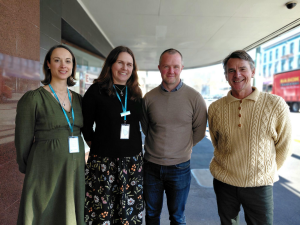
The Integration Team including Lucia, (replaced by) Jenny, Nick and Stuart
News
Pre-frailty: the overlooked opportunity in healthy ageing
25 Feb 2026
Here at WellSouth we are looking at pre-frailty and frailty screening in primary care to enable earlier identification and reduce acute admissions and bed days, while supporting people to remain well in their communities.
Frailty is commonly defined as “a state of increased vulnerability to a range of adverse health outcomes”, including higher rates of hospital admission and increased risks of falls (1).
Whilst Pre-frailty represents an intermediate, transitional state between robustness and frailty. Importantly, with the right interventions, it is potentially reversible (2). Early intervention can reduce pressure on hospitals and support people to remain well in their communities.
We propose a validated, practical screen tool that assesses:
-
Unintentional weight loss
-
Self-reported exhaustion
-
Low energy expenditure
-
Slow gait speed
-
Weak grip strength.
This enables people to be identified as Robust, Pre-Frail or Frail – and directed into more appropriate and timely pathways of care.
We are also focusing on what comes after screening. Many evidence-based services already exist across our system, but they can be difficult to navigate. Our work will be bringing these together into clearer, more coordinated pathways - making it easier for clinicians to refer and for patients to
This is about shifting the dial to more proactive, coordinated interventions that make sense for the patient and communities.
We are taking action to strengthen the integration and delivery of care in the community.
Watch this space,
Nick.
1. Clegg, A., Rockwood, K., Romero-Ortuno, R., Cunningham, C. (2021). Silver book II: Frailty. . https://www.bgs.org.uk/resources/silver-book-ii-frailty.
2. Sezgin, D., Liew, A., O’Donovan, M., O’Caoimh, R. (2020). Pre-frailty as a multi-dimensional construct: A systematic review of definitions in the scientific literature. Geriatric Nursing 41(2). https://doi.org/10.1016/j.gerinurse.2019.08.004
3. Morely, J., Malmstrom, T., Miller, D. (2023). A simple frailty questionnaire (FRAIL) predicts outcomes in middle aged African Americans. The Journal of nutrition, health and aging (16). https://doi.org/10.1007/s12603-012-0084-2
Our Ways of Working: Lean, Agile, and Impact-Driven
12 September 2025
The Southern region is facing a sizable challenge with respect to supporting the New Dunedin Hospital (NDH). This isn’t just about aligning services – it’s about shifting how and where care is delivered and helping ensure that hospital-based capacity doesn’t become overwhelmed on day one.
The goal we are working toward is bold:
"To support a sustainable health system by enabling the shift of care from hospital to community, integrating primary care and hospital services – supporting a 30% efficiency gain in medical/surgical bed days by the opening of the NDH Inpatient Building in 2031."
To meet this goal, we’ve chosen to work differently. At the heart of our approach is a commitment to lean and agile ways of working.
Why Lean and Agile?
Because the problem is complex, and the stakes are high. Health systems are not static – they are dynamic, interdependent, and always evolving. Traditional project approaches often fall short in this kind of environment. That’s why we’ve chosen a lean and agile approach to guide our work.
With a small team and a big objective, we’ve prioritised value over volume – focusing only on the work that meaningfully contributes to our core objective.
What Agile Looks Like at WellSouth
With the support of an agile expert from within our team, we’ve embedded agile ways of working into the project framework. That means:
ü Fortnightly sprints – breaking complex problems into small, manageable goals we can deliver on every two weeks
ü Quarterly release goals – ensuring alignment to our long-term objectives and creating tangible progress milestones
ü Regular retrospectives – to reflect, learn, and improve how we work as a team – embedding a continuous quality improvement approach
ü Transparent documentation – This is a system issue to solve so we are remaining transparent about our approach, our finding and our outcomes. To see how we’re working and what we’re learning visit our website WellSouth - Integration Team.
Staying Outcome-Focused
We don’t measure our success by how many meetings we’ve had or how many reports we’ve written. We measure it by whether we’re moving the needle toward a sustainable, integrated health system. Every sprint, release and planning session is focused on moving forward toward that outcome.
Agility isn’t about moving fast for the sake of it. It’s about responding quickly to what matters most. By applying agile principles within a health system context, we’re staying flexible, focused, and ready to adapt to new insights or shifts as they arise.
What this means for the system
By working in this way, we’re not just delivering a project – we’re supporting and strengthening a system. We aim to drive a system shift toward community-based care, better coordination across services, and more efficient use of healthcare resources.
Ultimately, our ways of working are designed to serve the people and communities of the Southern region – ensuring that when the New Dunedin Hospital opens its doors, it does so with a system around it that is smarter, leaner, and more sustainable.